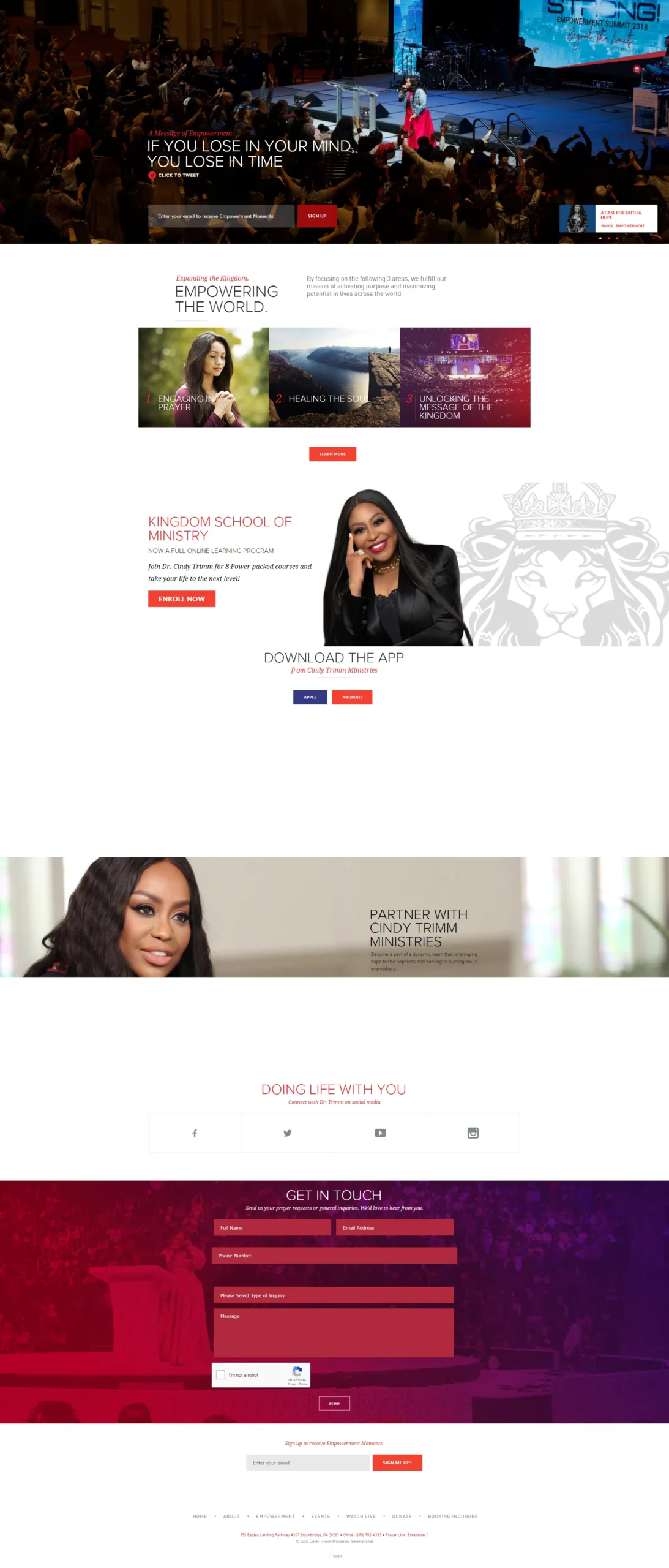
Quick Answer: Cindy Trimm is a life coach, author, and nonprofit founder who needed a website that could promote her speaking events, books, and mission work all at once. We built a WordPress site with event listings, book promotion, donation paths, and a clear personal brand presence. This case study breaks down the problem, what we built, and why it works for coaches with multiple revenue streams.
Most life coaches have one website problem. They need to explain what they do and make it easy to book. Cindy Trimm had a more complex problem: she needed one website that could promote a personal brand, sell books, list speaking events, and collect donations for her nonprofit — without any of those competing with each other.
That is a much harder design problem. A personal brand website has to feel cohesive, but it also has to give four different audiences (coaching clients, book readers, event organizers, and donors) a clear path without overwhelming any of them.
We built the site to handle all four. Here is what went into it, and why it works for coaches with multiple revenue streams.
If you want the full breakdown of what a personal brand website costs, see our WordPress web design pricing.
The problem
Three issues stood out before we touched a single line of code.
The personal brand was fragmented. A life coach with a book, a speaking career, and a nonprofit has multiple identities. If each one lives on a separate page with a different visual style and a different tone, the site feels like four different sites stitched together. Visitors do not know where to go, and the brand does not feel cohesive.
The event listings were not easy to find. Speaking events are one of the highest-value parts of a coach’s business, but they are also the easiest to bury on a website. If an event organizer has to dig through the site to find out where Cindy is speaking next, they will move on to a different speaker.
The donation path was not clear. The nonprofit is an important part of Cindy’s work, but donations were not a visible part of the site. Donors who wanted to support the mission had to figure out how. That is a conversion problem, and it is common in personal-brand-plus-nonprofit websites.
The result was a site that tried to do too much and ended up doing none of it clearly.
What we built
We rebuilt Cindy Trimm’s site on WordPress. Here is what went into it.
A cohesive personal brand
The site starts with a clear personal brand:
- A hero section that says who Cindy is, what she does, and who she helps
- A consistent visual identity across every page
- Professional photography that reflects her stage presence and her work
- Typography and color that feel warm, credible, and premium
This is the same brand-first approach we use on every WordPress website we build. For a personal brand, the design is not decoration. It is the first signal of whether the person behind the brand is credible.
Event listings that are easy to find
Speaking events are now a first-class part of the site:
- Upcoming events visible on the homepage
- A dedicated events page with dates, locations, and booking links
- Clear “Book Dr. Trimm” calls to action for event organizers
- Past events archived for credibility
If you want to see how we handled a similar event-driven structure for a different coaching practice, see our Soulfully case study.
Book promotion built into the site
Cindy’s books are a core part of her brand. The new site gives them real estate:
- A dedicated books page with covers, descriptions, and purchase links
- Book mentions in the hero section and on the about page
- A clear “Buy the book” call to action
This is not a separate store. It is an integrated part of the site, so a visitor who arrives for one reason (the book) can discover the others (coaching, events, nonprofit).
Donation paths for the nonprofit
The nonprofit side of Cindy’s work now has a clear donation flow:
- A dedicated nonprofit page that tells the mission story
- A visible donate button on the nonprofit page and the homepage
- Clear impact numbers that show what donations support
- Multiple payment options
For a personal brand with a nonprofit attached, this matters. Donors want to know their money is going to a real mission, and the site now makes that easy to see and act on. If you want to see how we approached the same challenge for a standalone nonprofit, see our Santa Ana Foundation case study.
A mobile-first build
Most people who discover a coach through a podcast, a book, or a social post are on their phone. The new site was designed for mobile first: the events, books, and donation paths all work on a phone, and the visual identity holds up on a small screen.
A technical SEO foundation
The new site has:
- Clean heading hierarchy on every page
- Schema markup for person, organization, events, and books
- Fast load times
- Descriptive meta titles and descriptions
- A structure that Google and AI assistants can read and cite
That foundation is what makes the site visible in search before the visitor even arrives. See our SEO, AIO, and GEO services for what that looks like as an ongoing program.
The result
Here is what changed, measured against the original site.
| Metric | Before | After |
|---|---|---|
| Platform | Legacy build | WordPress |
| Personal brand | Fragmented | Cohesive, consistent |
| Event listings | Buried | First-class, on homepage and dedicated page |
| Book promotion | Minimal | Integrated throughout the site |
| Donation paths | Unclear | Clear mission page + visible donate button |
| Mobile experience | Functional | Mobile-first |
| SEO foundation | Basic | Structured for search and AI |
Honest note: We are not publishing a specific conversion rate, traffic number, or donation count for Cindy Trimm yet because the tracking window is still open and the client has not approved publishing those figures. When we have verified numbers we can share, we will update this case study. We would rather show you a real number later than an inflated one now.
If you want to see projects where we do have verified conversion data, our portfolio includes sites with published CVRs ranging from 4.9% to 7.2%.
If you want to see the Cindy Trimm site live or walk through the design decisions, get in touch and we will set it up.
Why this matters for coaches with multiple revenue streams
Most coaches start with one offering (one-on-one coaching), then add more (books, events, group programs, a nonprofit or foundation). The website has to grow with them.
If your site only has one path, you are leaving money on the table. A visitor who came for your book might also want coaching. A donor who came for the nonprofit might also want to attend an event. A coach with a real business needs a site that gives each audience a clear path without making any of them feel secondary.
Three things decide whether that works:
- Does the brand feel cohesive across every offering? A consistent visual identity does that. A stitched-together site does not.
- Are the highest-value offerings easy to find? First-class event listings and book promotion do that. Buried pages do not.
- Is the donation path clear? A dedicated mission page with a visible donate button does that. A hidden donation form does not.
Cindy Trimm’s site now has all three. That is what a multi-revenue personal brand looks like in practice.
If you are a coach with multiple offerings and your site has any of the problems above, a free website health check will tell you exactly what to fix first.
Frequently asked questions
How long does a personal brand website take to build?
Most personal brand websites for coaches take 5 to 10 business days from approval, depending on how many pages (events, books, nonprofit, coaching) you need and how quickly you provide content and photography. A multi-offering site like Cindy Trimm’s usually takes 2 to 3 weeks.
How much does a personal brand website cost?
Most personal brand websites start at $1,200 for a starter build with up to 5 pages, or $2,400 for a growth build with up to 10 pages including event listings, book promotion, and donation paths. Custom builds start at $4,000. See the full breakdown on our website cost guide.
Can I have both a coaching business and a nonprofit on one website?
Yes. Cindy Trimm’s site integrates coaching, books, events, and nonprofit donations in one cohesive brand. We build the nonprofit as a dedicated section with a clear donation flow, without making it feel like a separate site.
Do you build personal brand websites on WordPress only?
WordPress is our default for personal brand websites because it gives you the best control over design, event listings, book promotion, and SEO. We also build on other platforms when that is the right fit, and we will recommend the platform based on your goals, not our preference.
Can you improve the personal brand of my existing coaching website?
In many cases, yes. Sometimes the fix is a cohesive visual identity and better event and book promotion. Sometimes it is a full rebuild. A free website health check will tell you which path makes sense for your site.
See what your personal brand website could look like
Tell us about your work, your offerings, and the audiences you serve. We reply within 24 hours with a custom recommendation and a plan for a free demo. No obligation, no pressure.
Prefer to chat first? Message us on WhatsApp and we will reply during business hours.
Related reading: