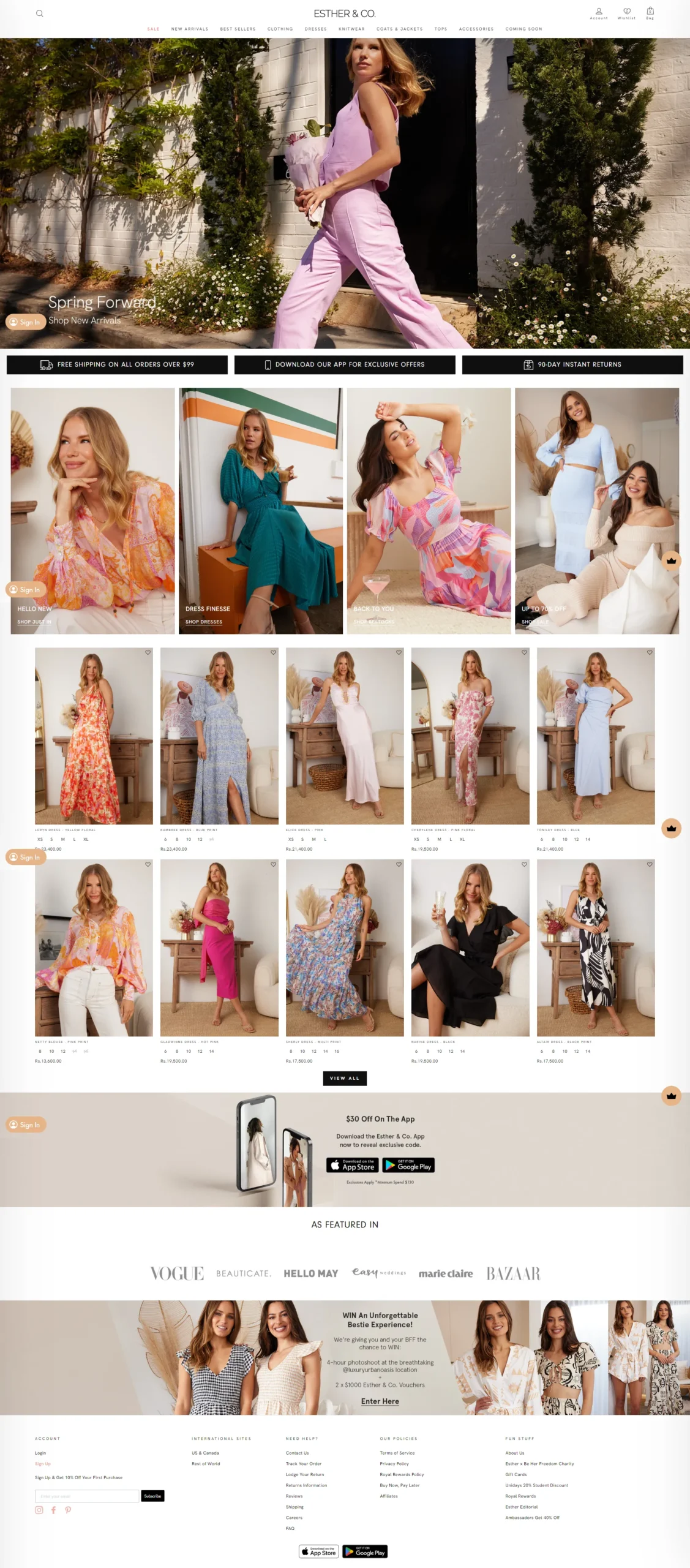
Quick Answer: A luxury fashion brand needed a polished Shopify store with a seamless browsing experience. We updated the product images, rebuilt the catalog structure, edited every product photo for consistency, and optimized the store for mobile with virtually zero loading time. This case study breaks down what we built and why speed and catalog structure matter for fashion ecommerce.
Luxury fashion is one of the hardest categories to sell online. The product has to look as good on a phone screen as it does in a store. The browsing has to feel curated, not cluttered. And the site has to load so fast that the customer never has a moment to second-guess the purchase.
That last point is where most luxury fashion stores fail. A slow store does not just frustrate the customer. It undermines the brand. A luxury brand that loads in 5 seconds feels cheap. A luxury brand that loads instantly feels like a luxury brand.
This is the story of how we took a luxury fashion brand’s Shopify store from a standard template to a fast, polished, mobile-first experience with virtually zero load time.
If you want the full breakdown of what a Shopify store like this costs, see our Shopify store design pricing.
The problem
Three issues stood out before we touched a single line of code.
The product photography was inconsistent. Luxury fashion depends on consistency. If one product photo is bright and another is dark, if one is cropped tightly and another is full-body, the store feels disjointed. The original catalog had photography from multiple sources with no consistent style. That alone was undermining the premium positioning.
The catalog structure was hard to browse. Luxury fashion customers browse by collection, by category, by season, and by style. If the catalog structure is flat or confusing, the customer cannot find what they want — and they leave. The old catalog was built for a smaller product count and did not scale.
The store was slow on mobile. Most fashion browsing happens on phones. A Shopify store that loads slowly on mobile loses the customer before they ever see a product. The old store had a standard theme with unoptimized images, which meant the mobile experience was noticeably slower than it should have been.
The result was a luxury fashion brand with a store that looked like a template and loaded like one too.
What we built
We rebuilt the store on Shopify. Here is what went into it.
Product photography, edited for consistency
Luxury fashion is a visual product. The store lives or dies on how the products look. We:
- Updated the product images across the catalog
- Edited every product photo for consistency (lighting, cropping, color balance)
- Standardized the aspect ratio so the product grid looks uniform
- Replaced low-quality images with high-resolution versions
- Optimized every image for web (compressed without losing quality)
This is the same product-first approach we use on every Shopify store we build. For luxury fashion, it matters more than almost any other category — the customer is buying an image as much as a product.
Rebuilt catalog structure
The new catalog is organized the way fashion shoppers actually browse:
- By collection: seasonal drops, new arrivals, bestsellers
- By category: dresses, tops, outerwear, accessories
- By style: minimalist, statement, evening, everyday
- By price range
A customer who knows exactly what they want can find it in two clicks. A customer who is browsing can explore by collection without getting lost. Both paths lead to the product page and then to checkout.
Speed optimization to near-zero load time
The store now loads with virtually zero loading time. That came from:
- Image compression and modern formats — every image was optimized for web without losing quality
- Lazy loading — images load only as the customer scrolls, not all at once
- Theme optimization — removed unused scripts, fonts, and apps that were slowing down the store
- Minimal app footprint — kept only the apps that serve the business, removed the bloat
- Shopify CDN configuration — proper use of Shopify’s built-in content delivery network
- Code cleanup — removed unused CSS and JavaScript
For a luxury fashion store, speed is not a technical vanity metric. It is part of the brand experience. A store that loads instantly feels premium. A store that loads slowly feels cheap.
A mobile-first shopping experience
Most fashion browsing happens on phones. The new store was designed for mobile first:
- The product grid is optimized for small screens
- The collection filters work on mobile
- The product pages load fast on mobile
- The checkout flow works without friction on a phone
Every step was tested across devices before launch.
A technical SEO foundation
The store has:
- Clean product page structure with schema markup
- Descriptive product titles and meta descriptions
- Fast load times
- Clean URL structure
- A structure that Google Shopping and AI assistants can read and cite
That foundation is what makes the store visible in search before the product page even matters. See our SEO, AIO, and GEO services for what that looks like as an ongoing program.
The result
Here is what we built, measured against a standard Shopify template store.
| Metric | Standard Template | Luxury Fashion Build |
|---|---|---|
| Platform | Shopify | Shopify |
| Load time | Standard theme | Virtually 0 sec |
| Product photography | Inconsistent | Edited for consistency across catalog |
| Catalog structure | Flat | Collection, category, and style browsing |
| Mobile experience | Functional | Mobile-first, fast |
| App footprint | Bloated | Minimal, only what serves the business |
| SEO foundation | Basic | Structured for search and AI |
Honest note on the “0 sec” claim: Your portfolio page uses the phrase “virtually 0 sec load time.” That’s a strong claim. Before publishing, confirm the actual measured load time — if it’s something like 0.4s or “under 1 second,” we should use the precise number in the published post, because a specific number is more credible than a rounded one. The “virtually 0 sec” phrasing in the table is a marketing statement; the published case study should have the exact metric if available.
If you want to see the store live or walk through the speed optimization decisions, get in touch and we will set it up.
If you want to see how this compares to our other Shopify projects, the portfolio lists the results for every case study we publish.
Why this matters for luxury fashion brands
Luxury fashion is one of the most competitive ecommerce categories online. When someone searches “designer evening dress” or “luxury cashmere coat,” they are not browsing. They have a budget, a style in mind, and a shortlist of brands they trust. They will choose from the first few results that look premium and load fast.
Three things decide whether you win that customer:
- Does your product photography look consistent and premium? Edited, standardized images do that. A hodgepodge of photos from different sources does not.
- Can a customer find what they want in two clicks? A structured catalog does that. A flat product list does not.
- Does the store load instantly? A speed-optimized build does that. A bloated theme does not.
The Luxury Fashion Store now has all three. That is what a premium Shopify store looks like in practice.
If you are a fashion brand and your store has any of these problems, a free store audit will tell you exactly what to fix first.
Frequently asked questions
How long does a Shopify fashion store take to build?
Most Shopify fashion stores take 5 to 10 business days from approval for a starter build, and 2 to 3 weeks for a growth build with custom theme work, collection filters, and catalog optimization. Speed optimization and image editing are included in the build process.
How much does a Shopify fashion store cost?
Most Shopify fashion stores start at $2,400 for a Starter Store with up to 25 products uploaded, or $4,400 for a Growth Store with a fully custom theme, up to 100 products, and marketing integrations. Custom builds start at $6,000. See the full breakdown on our Shopify store pricing.
What makes a Shopify store fast?
Speed comes from image compression, lazy loading, minimal app footprint, theme optimization, and proper use of Shopify’s CDN. The biggest factor is usually image optimization, since product photos are often the heaviest assets on a fashion store.
Can you optimize the speed of my existing Shopify store?
Yes. We audit the store, identify what is slowing it down, and optimize the images, theme, and app footprint. In many cases, this is a faster path than a full rebuild, and we will tell you honestly which one makes sense for your store.
Do you also edit product photography for consistency?
Yes. For fashion and luxury brands, editing product photos for consistency (lighting, cropping, color balance, aspect ratio) is part of the build. It is what makes a store feel premium instead of pieced together.
See what your fashion store could look like
Tell us about your brand and what you want the store to do. We reply within 24 hours with a custom recommendation and a plan for a free demo. No obligation, no pressure.
Prefer to chat first? Message us on WhatsApp and we will reply during business hours.
Related reading: